
Hair Blog 2020 | By Althea R. Gooden, Board Certified Trichologist
A relaxer is a chemical service that permanently alters the natural curl pattern of the hair. When performed correctly, on suitable hair, with proper preparation and aftercare, it can be a beautiful and manageable service. However, a relaxer should never be treated as a routine service that every client automatically needs.
The first question should always be:
Is your hair and scalp a good candidate for a relaxer?
Who Should Relax Your Hair?
Your hair should be relaxed by a licensed, properly trained professional cosmetologist who understands hair structure, scalp protection, chemical processing, timing, and corrective treatment.
A professional should examine the condition of your:
- Hair shaft
- New growth
- Scalp
- Previous chemical services
- Hair density and texture
- Porosity and elasticity
- History of breakage
- Previous relaxer applications
A professional should also ask about recent coloring, bleaching, heat damage, excessive shedding, scalp irritation, or previous chemical reactions.
When You May NOT Be Ready for a Relaxer
A relaxer may not be appropriate if the scalp is irritated, scratched, inflamed, burned, or experiencing an active scalp condition. Hair that is severely compromised, excessively porous, highly elastic, or breaking significantly may also need to be strengthened before considering another chemical service.
Healthy hair and scalp should always come before the desire for a particular hairstyle.
Preparing the Hair And Scalp Before a Relaxer
Preparation is one of the most important parts of a successful relaxer service.
Ideally, the hair should be assessed before the appointment. If the hair needs strengthening, a bond-repair or reconstructive treatment approximately one week before the relaxer can help prepare compromised hair.
The goal is not simply to make the hair straight. The goal is to maintain the integrity of the hair while achieving the desired result.
Avoid unnecessary manipulation, excessive heat, or additional chemical services immediately before relaxing.
The Relaxer Process
1. Protect the Hair and Scalp
Before applying the relaxer, the professional should protect the scalp and previously processed hair appropriately.
A scalp protector/barrier product may be applied according to the professional’s technique and the relaxer manufacturer’s directions. Previously relaxed hair should be protected because the relaxer should generally be applied to new growth only, not repeatedly over already-relaxed hair.
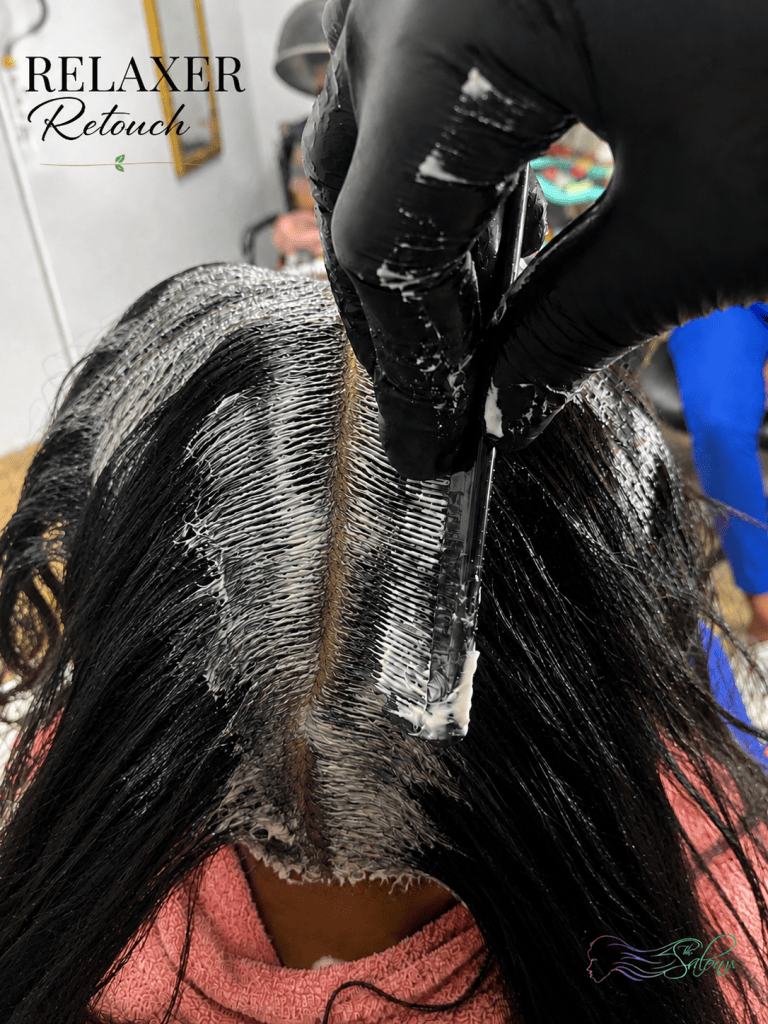
2. Apply the Relaxer to the New Growth
The relaxer is carefully applied to the new growth, avoiding unnecessary overlap onto previously relaxed hair.
Application should be controlled and professional. The goal is to process the new growth sufficiently without overprocessing the hair.
3. Processing Time
Processing time should be based on the specific relaxer manufacturer’s instructions, hair condition, texture, and professional assessment.
If the professional’s established protocol calls for approximately 20 minutes, the hair must still be monitored throughout the process. Twenty minutes should not be treated as a universal processing time for every relaxer or every client.
Never leave a relaxer on longer simply because you want the hair straighter. Overprocessing can increase the risk of breakage and scalp injury.
Removing the Relaxer
Once the appropriate processing time has been reached, the relaxer must be removed thoroughly.
Rinse the hair extremely well with plenty of water to remove the chemical from the hair and scalp.
It is also good professional practice to change the towel after the initial rinse so that residual relaxer is not transferred back onto the hair or skin.
The rinsing process should continue until the relaxer has been thoroughly removed.
Reconstructing the Hair
After the relaxer has been completely rinsed away, the next step is to begin restoring and strengthening the hair.
Apply a reconstructor according to the product directions and professional protocol. A 10-minute treatment may be appropriate for the particular reconstructing product being used.
Leave it on for approximately 10 minutes when directed, then rinse thoroughly.
This step is important because chemically processed hair needs care that addresses strength, moisture, and the condition of the hair fiber.
Neutralizing the Hair
Neutralizing is an essential part of the relaxer process.
A proper neutralizing shampoo helps remove remaining relaxer residue and brings the hair’s pH back toward its normal range. It also helps close the cuticle after the chemical process.
Skipping or rushing neutralization is not recommended.
The hair should be thoroughly neutralized according to the manufacturer’s instructions and the professional’s protocol before moving on to conditioning and styling.
Your Relaxer Service Does Not End When the Hair Is Straight
One of the biggest mistakes people make is thinking that the relaxer service ends after styling.
The real work begins with the aftercare.
Chemically processed hair needs a consistent regimen to help maintain strength, moisture, elasticity, and manageability.
One Week After the Relaxer
Approximately one week after the relaxer, consider a professional reconstructive or bond-repair treatment, particularly when the hair needs additional strengthening.
The purpose is to help support the hair’s structure and reduce the risk of breakage associated with chemical processing.
Remember:
Treat the hair before the chemical service. Treat the hair after the chemical service. Protect the hair between services.
How Often Should You Relax?
A relaxer should be applied to new growth only and should not be repeatedly overlapped onto previously relaxed hair.
The appropriate interval between relaxers depends on the individual’s rate of growth, hair condition, texture, and professional assessment.
Do not relax simply because you see new growth.
If the hair is breaking, excessively dry, weak, or the scalp is irritated, the next chemical service may need to be postponed.
The Professional Relaxer Checklist
Before relaxing, ask yourself:
Is my scalp healthy?
Is my hair strong enough for a chemical service?
Have I had excessive breakage?
Have I recently colored, bleached, or chemically processed my hair?
Has my hair been properly prepared?
Am I relaxing only the new growth?
Is my stylist licensed and properly trained?
Will my hair receive reconstructive/bond-support care before and after the service?
A relaxer can be a beautiful service—but it should be approached with knowledge, preparation, precision, and respect for the hair and scalp.
Final Thought From Your Trichologist
Don’t ask only, “Can I relax my hair?” Ask, “Is my hair healthy enough to be relaxed?”
Healthy hair should always be the priority. The right professional assessment, proper preparation, correct application, thorough rinsing and neutralization, and a consistent reconstruction and maintenance program can make a significant difference in the condition of chemically treated hair.
For more information about Hair & Scalp Health Do’s & Don’ts: Essential Tips for Lifelong Vibrancy and Wellness, visit:
You can also find additional hair and scalp health education from Althea R. Gooden on Amazon.