

To understand hair loss, we have to look at how a healthy follicle behaves. The cycle is divided into four distinct phases:
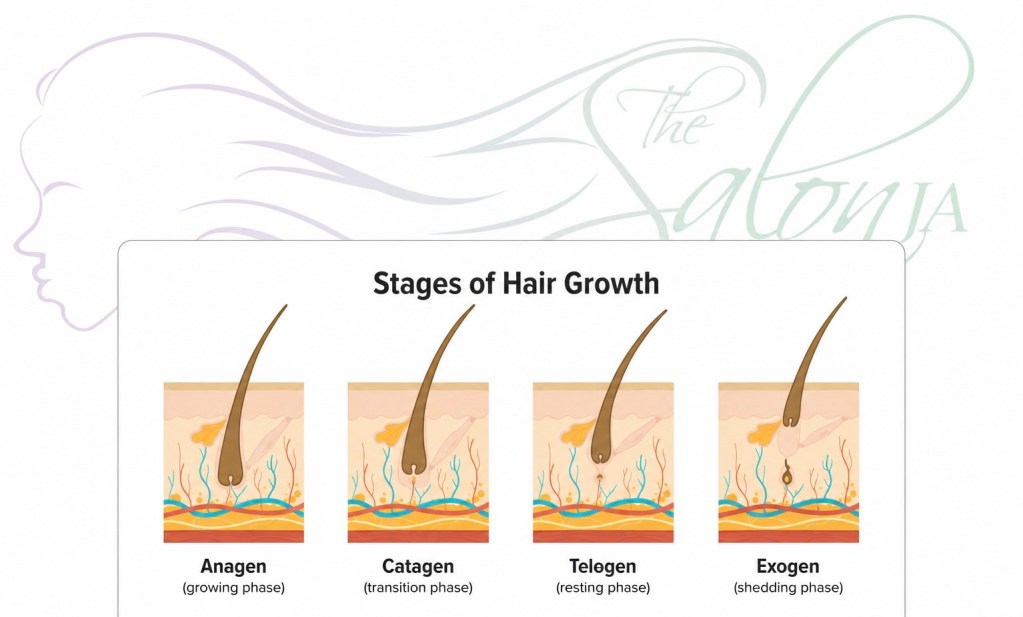
1. Anagen (The Growing Phase): This is the active growth period. Cells in the root of the hair divide rapidly, adding to the hair shaft. On a healthy scalp, about 85% to 90% of hairs are in this phase at any given time, and it lasts anywhere from 2 to 7 years. The length of this phase determines how long your hair can naturally grow.
2. Catagen (The Transition Phase): A short, microscopic breakdown stage lasting about 2 to 3 weeks. Here, the hair follicle shrinks, growth stops, and the hair detaches from the dermal papilla (the blood supply that feeds it).
3. Telogen (The Resting Phase): The follicle rests for roughly 3 months while the detached “club hair” sits anchored in the pocket. Around 10% to 15% of your scalp hair is resting at any moment.
4. Exogen (The Shedding Phase): An extension of the resting phase where the old hair is finally released from the follicle and drops out, often as a new anagen hair begins to push its way up from beneath to start the cycle over again. Losing 50 to 100 hairs a day here is completely normal.
What Happens When the Cycle is Disrupted?
When a systemic, hormonal, or environmental issue impacts the body, the hair cycle is usually the first luxury system the body shuts down to conserve energy. Depending on the trigger, the disruption typically manifests in two major ways:
1. The Sudden Shift: Telogen Effluvium (TE)
When the body experiences an acute shock such as high stress, illness, rapid weight loss, or major hormonal shifts it panics. Instead of the usual 10% of hairs entering the Telogen phase, up to 70% of active Anagen hairs are abruptly shocked into premature retirement.
About 2 to 3 months after the triggering event (the length of the Telogen phase), those hairs all hit the Exogen phase simultaneously. The result is massive, alarming shedding across the entire scalp.
2. The Slow Miniature: Androgenetic Alopecia (AGA)
With genetic hair thinning, the issue isn’t sudden shedding, but a progressive short-circuiting of the clock. Hormones like Dihydrotestosterone (DHT) bind to susceptible follicles and systematically shorten the Anagen phase while lengthening the Telogen phase.
Each time the hair cycles through, the follicle shrinks (miniaturization). The hair grows back finer, shorter, and more translucent until the follicle eventually produces only invisible vellus hair or closes entirely.
Conditions Best Treated by a clinical Trichologist !
Because hair loss is rarely just a “hair problem” and is almost always a “body or scalp problem,” a Trichologist bridges the crucial gap between cosmetic cosmetology and clinical dermatology. They look at the holistic, top-down ecosystem of the hair and scalp.
The specific types of hair loss and scalp disruptions that are exceptionally well-suited for a Trichologist include:
Diffused Thinning & Chronic Telogen Effluvium: Tracking down the internal deficiencies (like low ferritin, vitamin D, or thyroid imbalances) causing prolonged shedding.
Early-Stage Androgenetic Alopecia: Managing genetic thinning through topical stimulants, low-level laser therapy, DHT blockers ,micro needling, and targeted scalp nutrition before irreversible atrophy occurs.
Traction Alopecia: Designing mechanical recovery protocols and lifestyle changes to rescue follicles damaged by prolonged, excessive tension from styling.
Scalp Ecosystem Disorders: Managing inflammatory environments like severe Seborrheic Dermatitis, stubborn dandruff, psoriasis, or disrupted scalp pH, all of which directly impair the follicle’s ability to stay in a healthy Anagen phase.
